

11 Feb Interview: Bluecomotive Talks with… Cara de Espelho
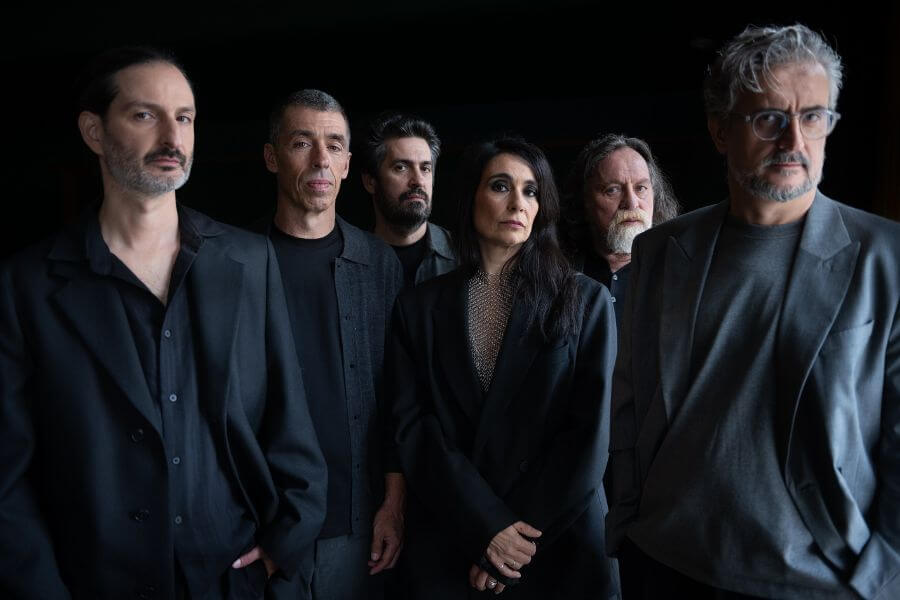
With their self-titled debut album, Cara de Espelho racked up awards, praise, devotion—and plenty of road dust. Even back then, you could already sense that in their songs, what unites us is greater than what divides us: a shared territory of unease about the world around us. Now, on their second record, Carlos Guerreiro (multi-instrumentalist), Luís J. Martins (guitar), Maria Antónia Mendes (vocals), Nuno Prata (bass), Pedro da Silva Martins (guitar) and Sérgio Nascimento (drums) sharpen that critical, biting взгляд—brilliant and hard-hitting as ever. On the new album “B”, times may have changed, but the urge to call out what, in this country, is allowed to fall into disrepute has not. They make our voice their own. Listen—and echo it.
When Cara de Espelho first emerged, this “supergroup,” as it was immediately labelled—rising from the ashes of other well-known projects—there was some doubt as to whether it would be a special, one-off venture, or whether we were witnessing the birth of a band built to last. Now, two years on, with two albums released, 19 months on the road behind them and a new tour announced, that doubt has finally been put to rest, right?
Sérgio Nascimento — When the idea of doing something together first came up, it was kind of like putting together a collection of people. We all liked each other’s work, and the people too. Then things started to take shape, and the message really began to gain form. It turned into this somewhat unstoppable train. Now we feel like we’re truly a band, and we want to keep doing a lot of things going forward, for as long as we’re here and healthy.
Your lyrics are often described as “a watchful gaze” on society—on what’s going wrong in the world in general and in Portugal in particular. The songs weave together news topics, political speeches, people’s reactions in the street and on social media. That watchful gaze is yours and the rest of the band’s, but is it also meant to be the people’s? Do you feel that reflection in the audience’s response to the songs?
Pedro da Silva Martins —Yes, in a way that relationship does exist between the audience and the songs, because people identify with the lyrics. I also try to write in a way that allows for a broad reading on the listener’s part. I think there are different layers of interpretation in the songs. That’s one of Cara de Espelho’s defining traits: to mirror Portugal a bit—this country, and even the world. And I think people see themselves reflected in that, so that connection to the lyrics becomes really important too.
When you receive lyrics written by Pedro da Silva Martins, and you’re finding your voice for them, you almost seem to invent a character for each song. That sense of theatricality is, of course, heightened on stage, live. But the question is: how much of you is there in each of those characters?
Maria Antónia Mendes — That’s a hard one to answer—it’s a very relevant question. Like an actor or actress, my body and my voice are there. But it’s not necessarily a real, true part of me that’s present. In some songs, maybe yes—it can involve some personal experience, some frame of an experience I’ve had, which inspires me to embody those words. But not necessarily: I can also draw on other people’s lives and try to represent them, or give voice to what’s happening in other people’s lives.
You musicians know the stigma surrounding the second album: after a highly acclaimed debut, there’s the pressure to live up to the expectations of both critics and audiences. On the new record B, how did you manage the balance between continuing the sound and visual aesthetic of the first album and adding new layers to your musical identity?
Luís J Martins — It was a natural growth of the band, and I think you can feel the experience of being on the road, of playing together more. Right now, we’re more of a band than we were at the beginning. The first album came out of songs developed at a distance, through file-sharing, partly because we started working during the pandemic. B was born out of that on-the-road energy. Because the whole process was lived in person, with everyone together, it’s a record that carries that band energy too. That good band vibe is one of the album’s defining identities.
There’s the expression “the man of seven instruments,” but on the new album B you play a dozen instruments, many of them built by you. Is that process of invention and construction part of the pleasure of being in Cara de Espelho? How do ideas come about—for instance, turning a bottle or a pot into an instrument?
Carlos Guerreiro —Music is a very broad, wide-ranging thing, and I think every musician relates to it differently. I’ve always felt more drawn to sound itself, to the production of sound, than to being a virtuoso on any one instrument. And that’s why these paths lead to other paths you didn’t foresee: things themselves end up generating other things. That’s where this slightly mad-musician side of me comes from. I look at my instruments and none of that is written down anywhere. But it’s not really my fault—that’s just the path they led me down.

The live debut of B is set for February 20 at Cineteatro Louletano, as part of a tour that will then pass through Lisbon (Culturgest), Famalicão (Casa das Artes), Aveiro (Teatro Aveirense) and Castelo Branco (Cine-Teatro Avenida), among other venues to be announced soon. Excited to unveil the new songs live?
Nuno Prata — Yes, we’re all excited to start playing the first shows. It’s a different kind of work from the studio: it’s about reworking the songs for the stage. It’s another small part of our creative work that really excites us—stitching the songs together, and weaving them in with the songs from the previous record, to come up with a setlist that makes sense and has a narrative. We’re excited because it’s always an important and interesting phase of the process, precisely because it continues to be a creative layer built on the work we’ve already done on the album.
“B” ON THE ROAD:

🎫 BUY TICKETS